HOUSING CRISIS · NIGERIA · MAY 2026
With cement prices surging 367% in seven years, projects being abandoned across Lagos and Abuja, and millions of Nigerians spending nearly everything they earn on rent, the numbers tell a deeply uncomfortable story
There is a question that haunts Nigeria's real estate sector one that developers, policymakers, and everyday Nigerians are increasingly asking out loud: are we moving closer to solving our housing crisis, or are we quietly watching it get worse? The answer, based on the latest data and ground-level reports, is both unsettling and urgent.
Nigeria's housing deficit, officially pegged at between 14.9 and 28 million unitsdepending on the methodology used, is not a new problem. But what is new in 2026 is the growing mountain of obstacles stacking up against any meaningful solution obstacles that are compounding faster than any government programme or private developer can keep up with.
28M—Housing units in deficit (estimated)
367%—Cement price rise over 7 years
30%—Cement price rise in Q1 2026 alone
₦15,000— Max price per 50kg bag of cement today
The Cement Problem No One Can Ignore
If there is one single story defining Nigerian real estate in 2026, it is this: the cost of building has become almost impossibly high for the vast majority of developers and households who need it most.
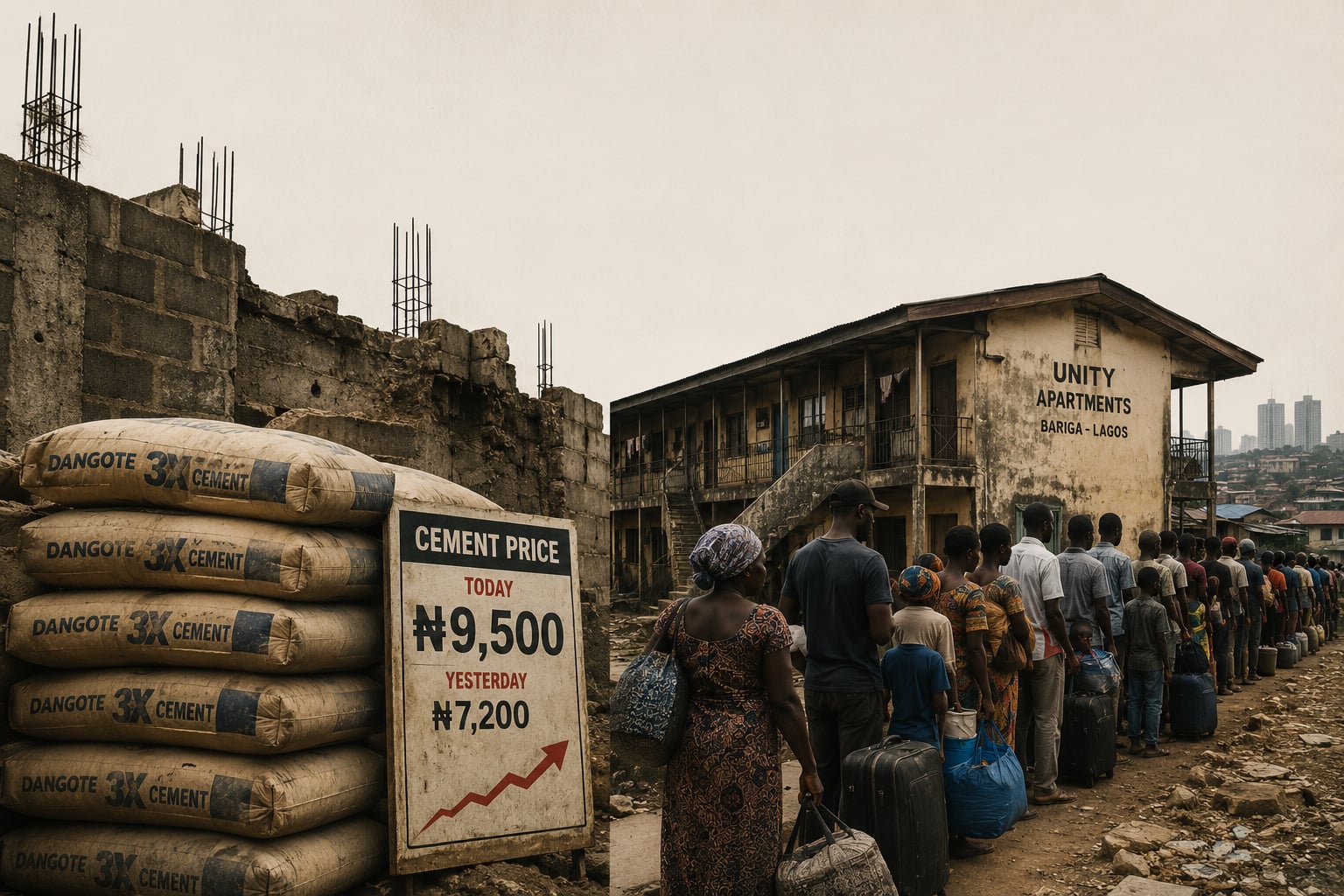
In late 2025, a 50kg bag of cement sold for approximately ₦7,500. By early 2026, that same bag was fetching between ₦11,500 and ₦15,000 across Lagos, Abuja, Ogun State, and the South-East a rise of more than 50% in just a few months. Zoom out further and the picture grows even more alarming: cement has surged by 367% over the past seven years, rising from between ₦2,400 and ₦3,000 per bag in 2019 to where it stands today.
"Projects are being abandoned, budgets renegotiated, and housing supply is contracting precisely when Nigeria's reported deficit demands the opposite.
It is not just cement. Steel materials are up 20%, sharp sand has risen by 25%, and iron rods have surged by more than 120% in select periods. For a developer who locked in a budget 18 months ago, these numbers represent a financial crisis mid-project and many are simply walking away.
According to PropComms Africa, a real estate intelligence and media platform, three manufacturers — Dangote Cement, BUA Cement, and Lafarge Africa — collectively control over 95% of Nigeria's domestic cement supply. That level of market concentration, critics argue, removes any meaningful competitive pressure that could keep prices in check. Manufacturers cite rising energy costs, foreign exchange volatility, and logistics challenges. But industry experts say these factors alone do not fully explain the pricing gap.
To complicate matters further, the Federal Government updated its import prohibition list in April 2026, banning cement imports as part of the 2026 Fiscal Policy Measures under the ECOWAS Common External Tariff framework. Stakeholders across the real estate sector have been blunt in their response: banning imports while domestic prices are already out of control is a policy that will deepen, not solve, the housing crisis.
BUILDING MATERIAL COST TRACKER — Q1 2026
Cement (50kg bag)₦11,500 – ₦15,000 ↑ 30% in Q1
Steel rods Up ~20% year-on-year
Sharp sand Up ~25% year-on-year
Iron rods Up 120%+ in select periods
Cement vs. 2019 priceUp over 367% in seven years
A Rental Market Under Extreme Pressure
The knock-on effect of all this is felt most painfully by ordinary Nigerians trying to find a decent place to live. When construction becomes expensive, developers build less. When less is built, the supply gap widens. When supply shrinks and demand grows as it relentlessly does in a country approaching 260 million people — rents explode.
In Lagos, the country's commercial nerve centre, two-bedroom apartments in prime areas like Lekki Phase 1 and Victoria Island now command between ₦6 million and ₦12 million per year. Even mainland neighbourhoods that once offered affordable alternatives — Ikeja, Magodo, Surulere have seen rents spike by nearly 30% within twelve months, as the middle class is priced off the Island and floods into what used to be budget-friendly territory, driving up prices there too.
In Rivers State, the situation has crossed into what can only be described as a social emergency: residents are reportedly spending over 100% of their monthly income on rent. This is not a metaphor. It means people are taking on debt, selling assets, or doubling up in cramped accommodations simply to keep a roof over their heads.
The rental affordability crisis, as many market participants now call it, is being driven by a toxic combination: severe housing scarcity, rising landlord costs, a weak naira making imported materials more expensive, and energy costs that have led landlords in serviced buildings to pass every diesel and solar levy directly onto tenants. Serviced apartments now command a 35% premium over equivalent unserviced units and yet, given Nigeria's power supply situation, that premium is often the price of simply having reliable electricity.
✦ ✦ ✦
So, Is Anything Actually Getting Better?
To be fair to the full picture, the news is not uniformly grim. Nigeria's real estate market has shown genuine resilience. By late 2025, inflation had begun to ease, currency conditions had stabilised, and investor confidence was recovering reflected in rising transaction volumes. Real estate agents surveyed in April 2026 reported growing optimism, and Abuja in particular is seeing policy-driven momentum as infrastructure development continues across the FCT.
The Federal Government has also approved a ₦250 billion investment in student hostels across tertiary institutions a move that acknowledges, at least, the housing needs of Nigeria's young population. Bayelsa State recently distributed 108 housing units to civil servants. And CBRE forecasts that commercial real estate investment will rise globally, with some of that confidence spilling into Nigeria's commercial segment.
Technology is also slowly reshaping how the market operates. Platforms focused on pricing transparency are beginning to address one of the sector's oldest problems: information asymmetry, where a two-bedroom flat in the same neighbourhood can have wildly different asking prices depending on who is negotiating. PropTech tools virtual tours, AI-driven valuations, and blockchain title verification are giving buyers and investors more confidence to transact without falling victim to fraud or inflated pricing.
And yet. The structural problems remain enormous. High interest rates and tight credit conditions mean that most developers still rely on equity, short-term capital, and informal funding rather than accessible mortgage financing. Nigeria's mortgage penetration rate remains one of the lowest in the world for an economy of its size. Without long-term affordable financing, the mass-market housing that millions of Nigerians desperately need simply cannot be built at scale — no matter how many policy statements emerge from Abuja.
The Verdict: Consolidation, Not Progress
The most honest description of Nigeria's housing market in 2026 is that it is in a consolidation phase a period where the economy is stabilising after painful reforms, but where the structural conditions needed for genuine housing progress have not yet materialised. Demand is strong. Supply is weakening. Costs are rising. And the people who need housing most are the ones being squeezed hardest.
For Nigeria to move from consolidation to genuine progress, several things need to happen: building material prices must be brought under control through either competition policy or coordinated regulatory action; mortgage financing must become accessible to middle and lower-income earners; and government housing programmes must move beyond announcements into delivery at meaningful scale.
None of that is impossible. Nigeria has the population, the urbanisation momentum, and increasingly the policy attention to tackle this challenge. But the clock is ticking. Every year that passes without real supply expansion is another year of rising rents, abandoned projects, and families priced further out of the dream of a decent home.
"Nigeria is not merely short of houses — it is short of livable homes.
The housing crisis is not a background issue in Nigeria. It is a frontline social and economic emergency one that will define the quality of life for tens of millions of Nigerians in the years ahead. The question is no longer whether Nigeria has a housing problem. The question is whether those with the power to fix it will move fast enough to matter.